
Process is good. But...
there are problems.

Last week’s post was about how great processes are. A process is a roadmap to success. But can a process become a rut? One of my favourite artists can help with that: she’s “anti-process😜.”
As I dialled in my approach over the past few years, my drawings became more similar. I suppose that’s another way of saying that I have a style. Lately, I’ve been wondering if I’m stuck doing the same thing, or is it just that I know what I am doing now after years of trial and error?
Reflecting on it more deeply, I know I am not stuck; I’m moving in new directions but only when I break my process. Sometimes, I can break it with new media, so I did a pink paper drawing with red, blue and white pens a few days ago.
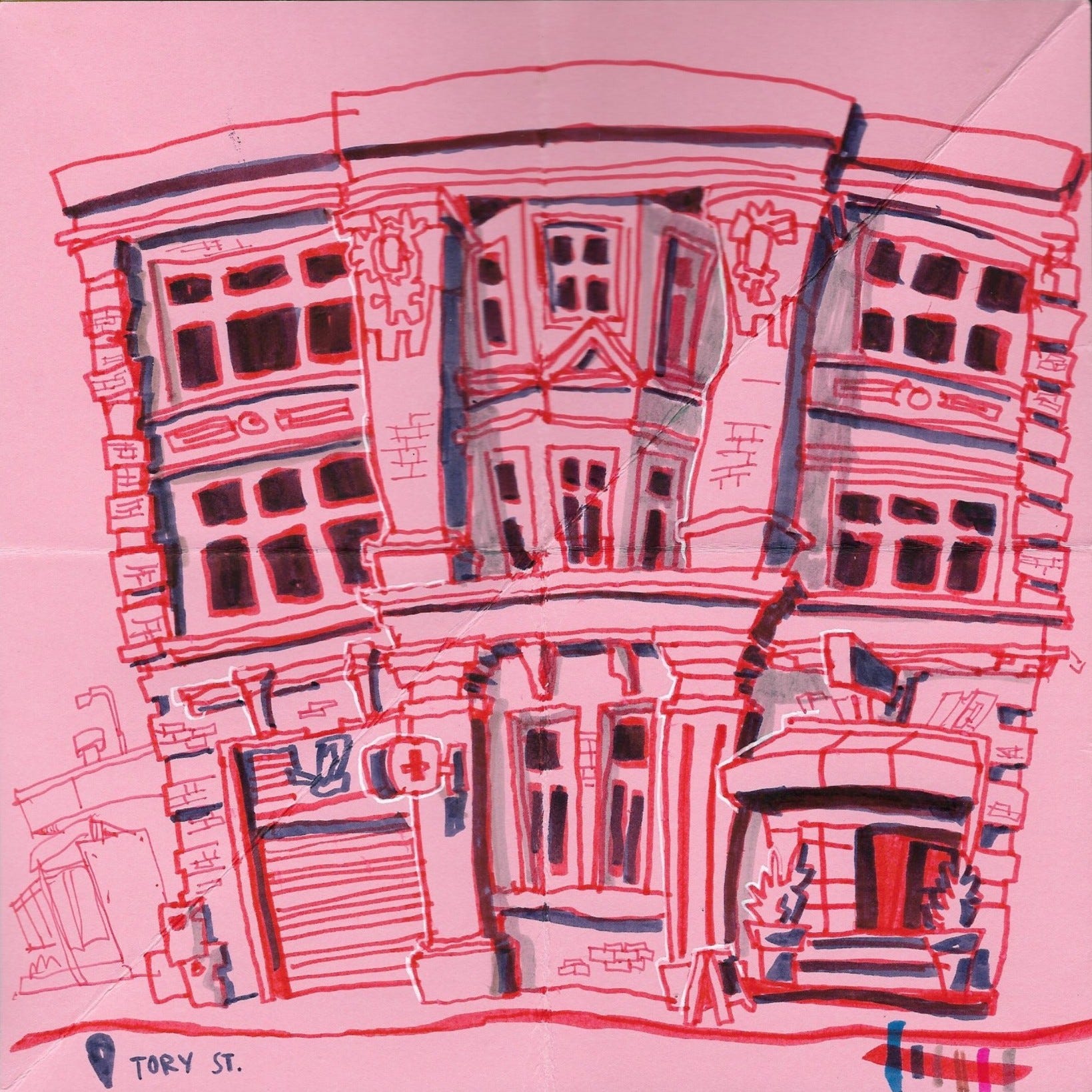
It looks different from my other work, but the process was the same. I think part of the problem is the media wasn’t different enough, and I could fall back on old habits. Forcing myself to use unfamiliar media combinations leads to new ideas; this happened to me with stolen markers and self-imposed restrictions.
Those moments lead to progress, and that proves that I am not stuck. But I need to keep throwing the process out the window from time to time if I want to keep learning new things. And I worked out how as I watched Seattle-based urban sketcher Eleanor Doughty draw some Lisbon laundry
If you don’t know Eleanor’s work, you’re missing out big time. She’s an incredible artist, writer and teacher. I’ve seen Eleanor demonstrate before when I took her workshop at the Urban Sketchers Symposium in Auckland in 2023. I have stolen more than my fair share of ideas from her, including starting this substack.
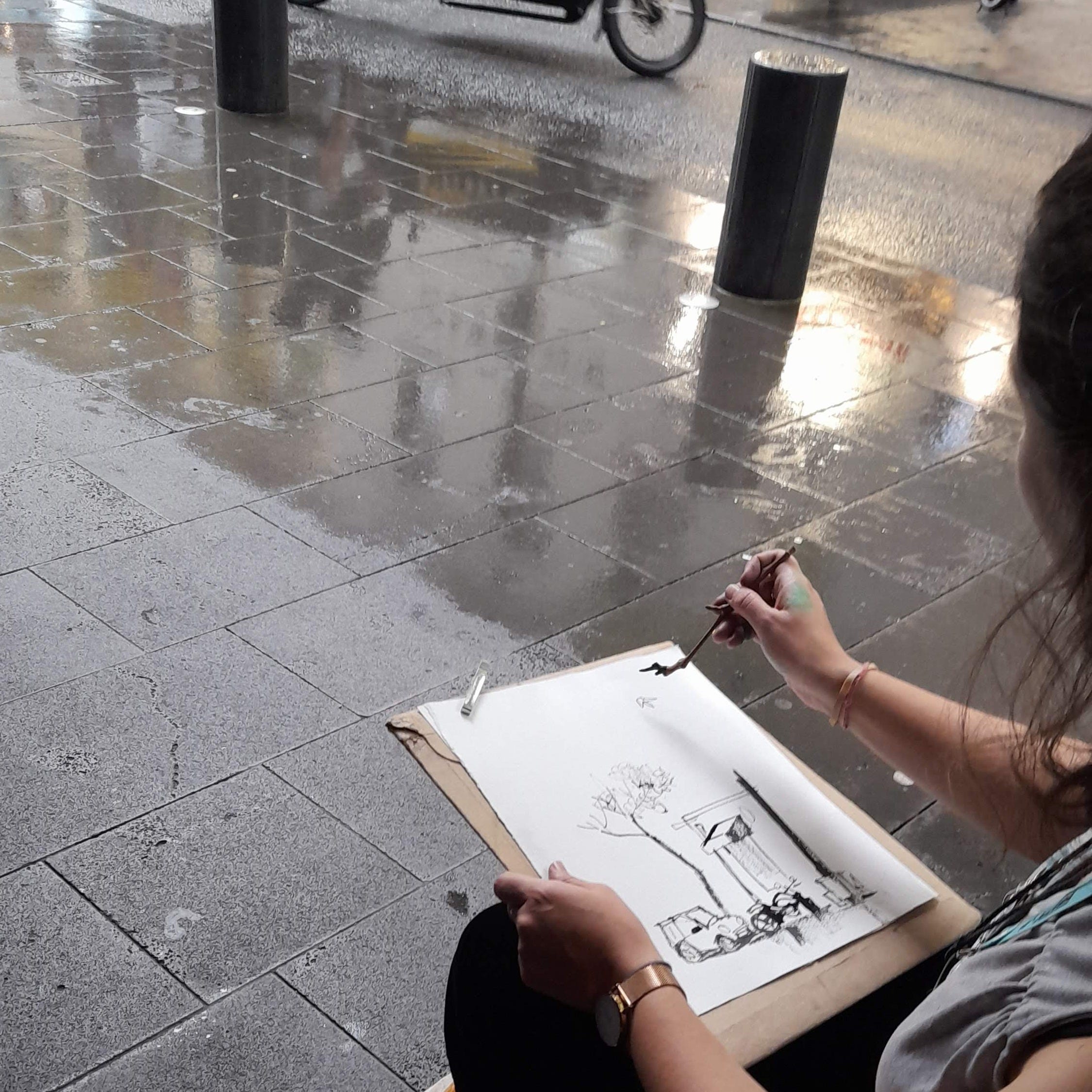
In Auckland, her approach was familiar: lines first, colours later. But this time, her process was almost a backwards version of what I was doing. I found the differences in approach fascinating.
As she did her demo, I did my own thing. Here’s what I came up with:
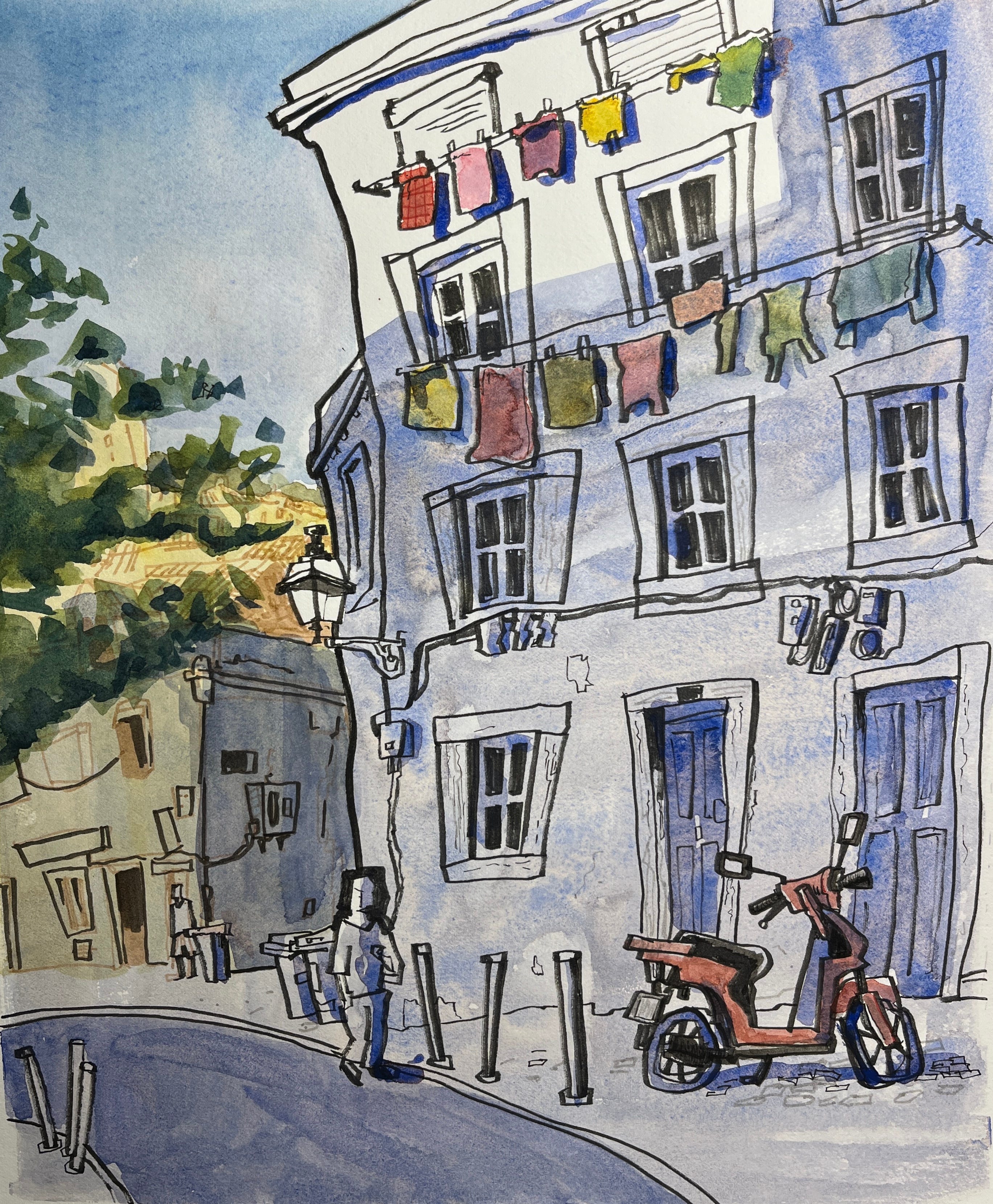
I started off by drawing the scooter in pen while she was making the big watercolour shape of the buildings. Later on, as Eleanor drew the scooter, I sloshed a big shadow wash on top of all my linework and colours.
I mapped out our processes in parallel below. Yellow is pen, purple is watercolour, and time passes as you move down the page.
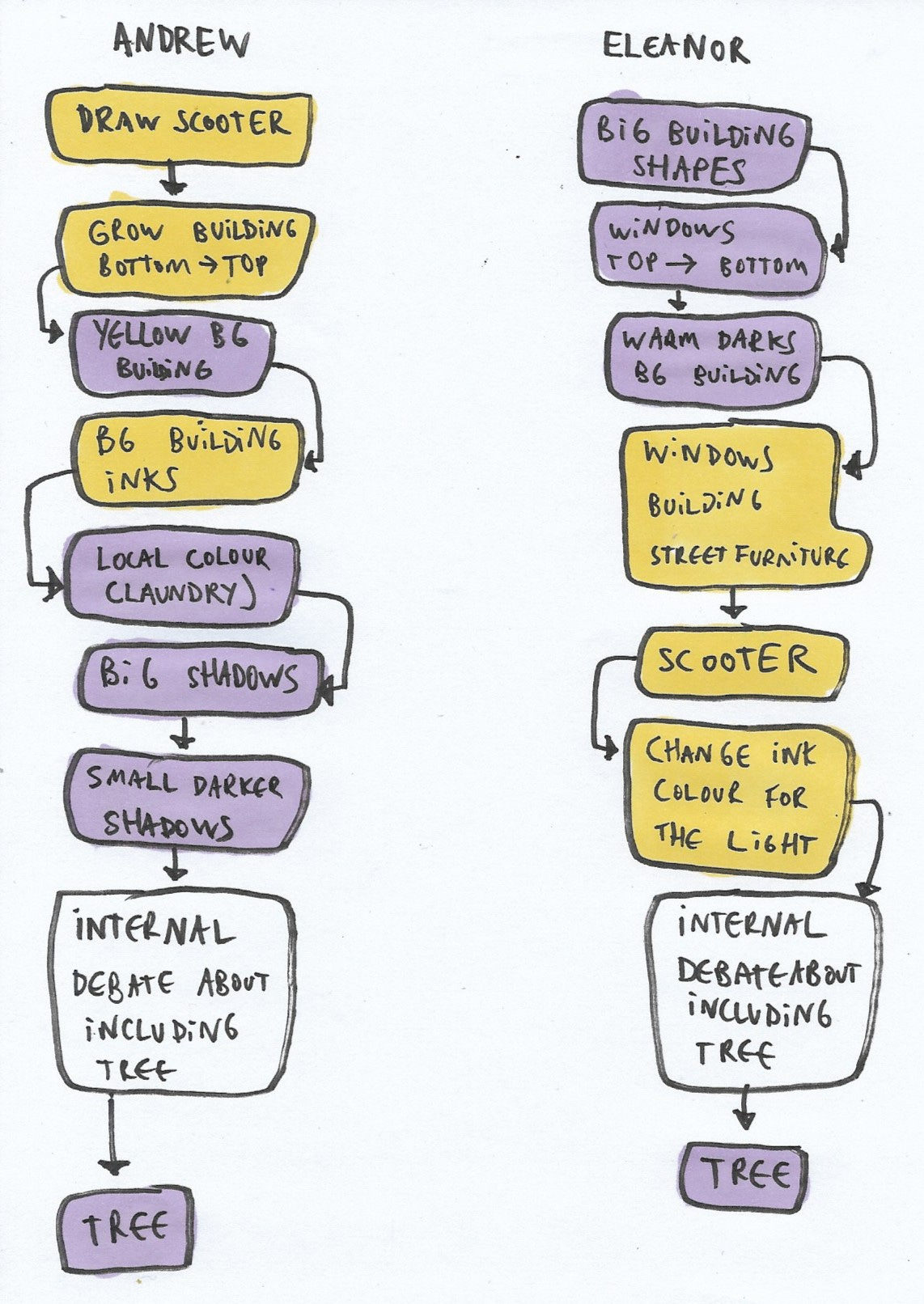
There were a lot of similar aspects and moments in our drawings. We both loved the cast shadows of the laundry, nudged that lamp to avoid a tangent, and had a simultaneous internal debate about the tree on the left.
We also have some similar habits; we both like unifying a painting by repeating the same colours and are reluctant to introduce an extra colour late in the piece.
But unlike my structured approach, Eleanor’s mixed media improvisation isn’t a straight line. The linear chart above doesn’t capture her improvisational nature. To me, it seems her process is a cycle. Eleanor draws or paints something, works out what problems exist in the picture, and then dips into a big bag of tools and techniques to solve those problems while keeping faith that it’ll work out.
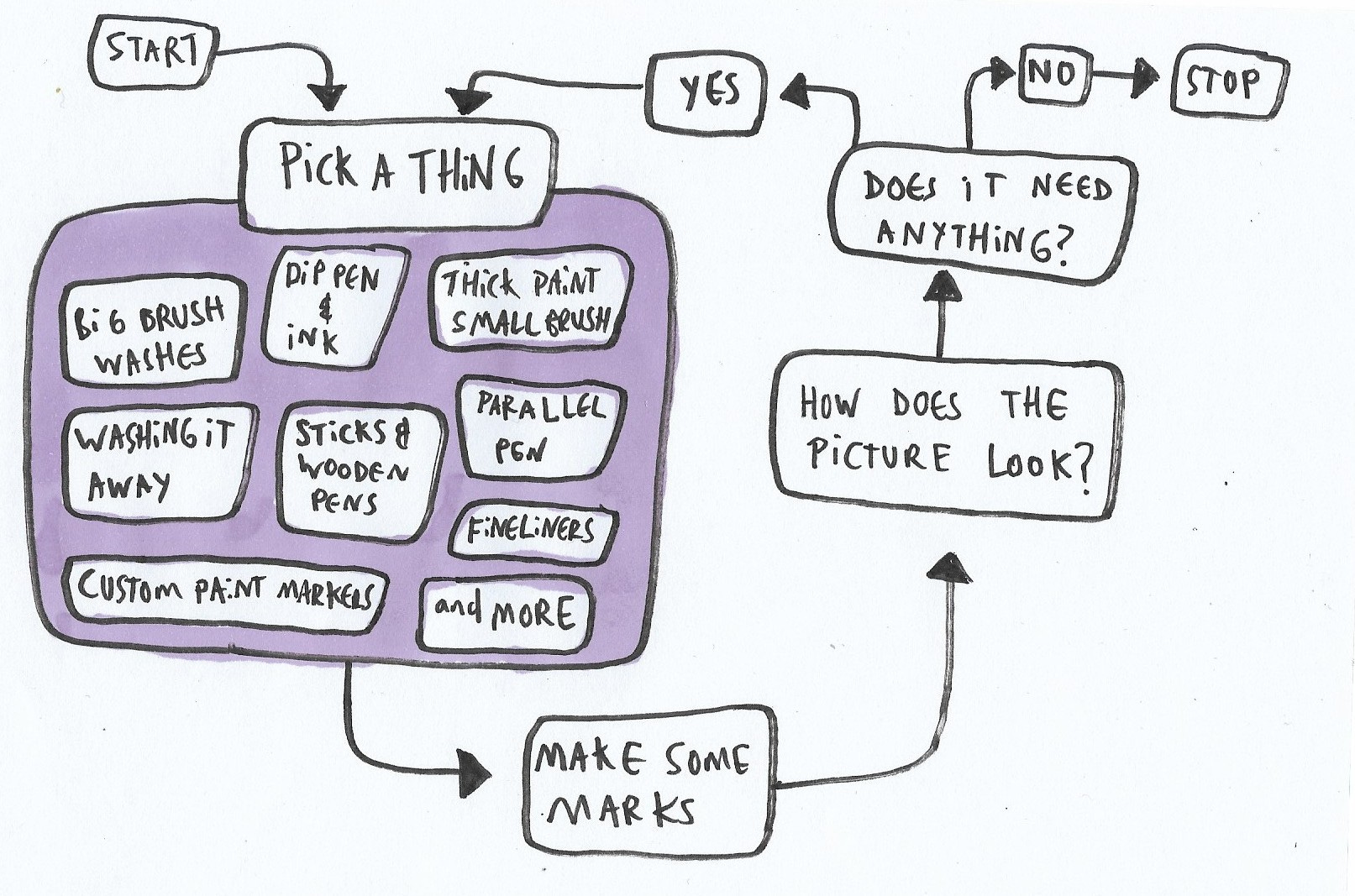
Eleanor has technical skills with a whole stack of media, but what inspires me most is her bravery in uncertainty—she admitted to being scared at times during the painting but just kept going.
I want to bring this continuous experimentation into my drawings, but it’s hard to justify. I can follow my process and end up with a decent drawing, so why should I take a risk? The fear of failure is so real!
But I must remember I have some technical skills, too; I know how to get myself out of trouble. I should have more faith in my abilities and let my process be more experimental and less predictable.
I learned so much from Eleanor’s demo, and I’m looking forward to the next one—she’s now doing these monthly for her paid subscribers. If you’d like to get more insights into her approach, check out how she drew Taipei 101 and consider subscribing.
So what am I saying? Is process a waste of time?
No. Having a process is good. Being clear about what you do leads to success. Refining and executing a process is a valid way to make a drawing. And I will keep following my normal process most of the time.
But be careful of it. Just like the rules, your process can make you stuck. It’s worth shaking it up or bending it around on itself sometimes.
However you do it, just keep on drawing.
Andrew
Andrew!! This summary of the demo from your perspective was so interesting for me. Also flattering 😊 the side by side flowchart is such a nice way to break down the processes, and you nailed it with the cyclical chart on my personal approach.
I love working that way because making a sketch is always interesting and surprising. Sometimes I keep it simple too — a simple pen drawing can fun and rewarding. I feel like my Best works all take a leap of faith — many times it doesn’t work out but when it does it’s amazing. So I keep trying!
The Auckland picture is so funny and yet so real 😂 bless Urban Sketchers for allowing us to meet in person!
As always Andrew, thought provoking and helpful to nudge me along in my journey. You’re motivating me to do my own flow chart - and I think I’ll add some specific prep steps to help me get in a good head space before putting pen to paper…and symbols to remind me to breathe 😅